Abel Tasman National Park - hiking a New Zealand coastline
Hiking in the Abel Tasman National Park is never a dull moment
The walk begins at the end of town, not far from a large car parking area and a lovely eating/drinking spot known as The Park Café. Signs advise how long it is to the next part of the track so that you can gauge exactly how far too walk. If I was doing a multi-day walk I would probably arrange a water taxi from Mapua to take me out further into the park. This enables a walk back along the coast finishing at The Park Café with a large glass of wine – surely the best way to end an incredible adventure. Today though I am just going to walk a short way – to dip my toes into this expansive but rewarding New Zealand coastal park. The sign tells me the distance, walking at an average person pace, to various beaches dotted along the park. I decide to allow my legs carry me as far as I can get.

Starting point of the Abel Tasman Great Walk
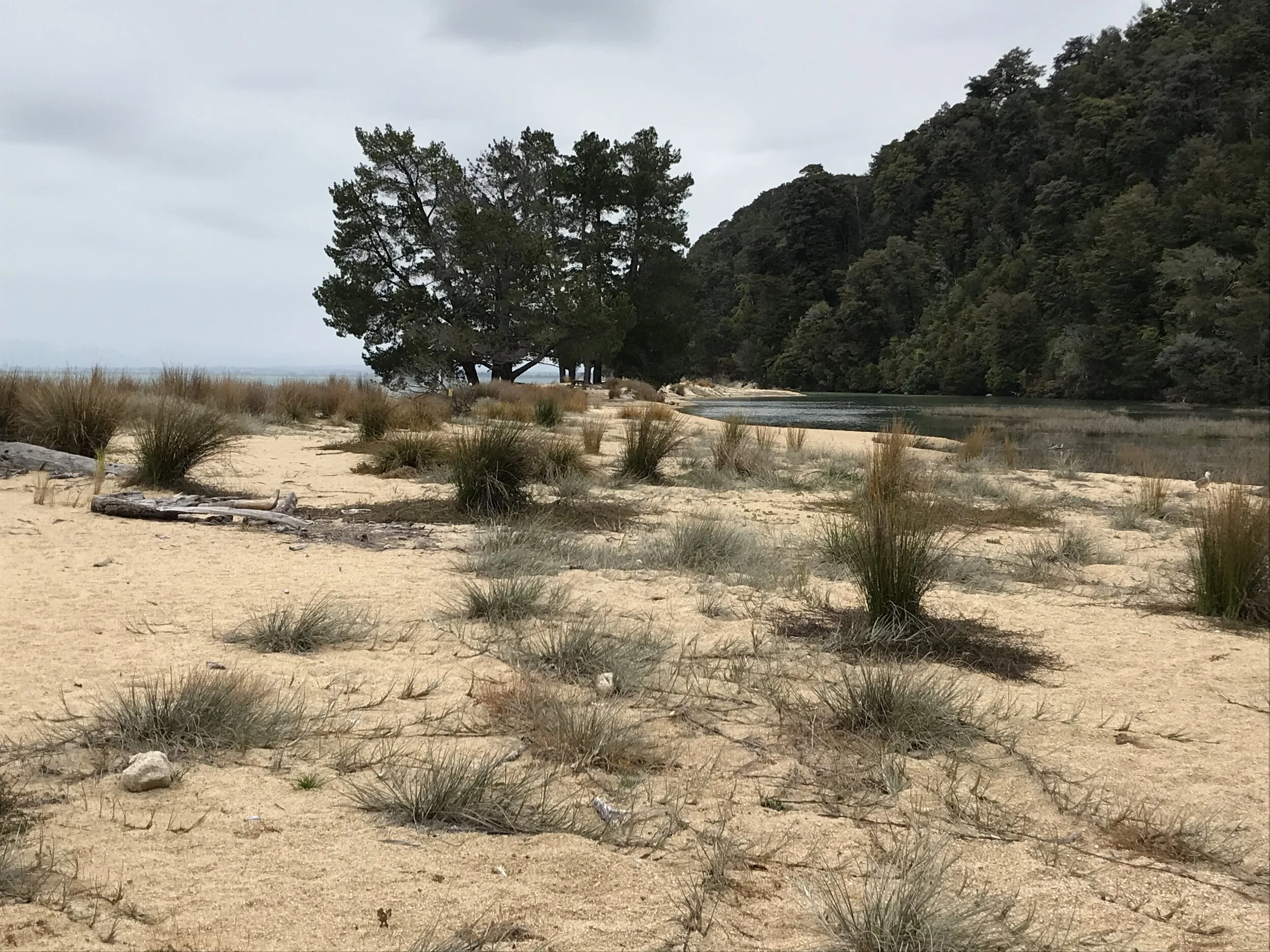
At first the walk traverses a boardwalk over the estuary, the tide is out and various sea birds frequent the area scrummaging on the sandy banks for morsels of food. I enter the start of the bush with a long sandy beach to my right hand side. It looks inviting but I press onwards further into the forest. There is some replanting taking place alongside the pathway as never-ending work continues to ensure the Abel Tasman remains as it was always supposed to be. The path way is sandy but stable although I have to keep my eye out for losses rocks and tree routes that jut through. I continue climbing steadily upwards and into denser bush.

A sandy stretch of beach along the Abel Tasman Track
Tin Cup beach is on my right, a short walk down hill and up on my left is the campsite which is a grass clearing ready for use by tents. As I continue onwards a weka wanders down the pathway towards me. He looks up and we peer at one another, hello weka I say, the weka responds by plunging into the nearest bush for safety. As I climb higher the views of the coastline beneath me begin to peek into view.

One of the many bays you can walk down too from the track
The teal green colour of the sea, a marine reserve, is mesmerizing on a sunny day. Further out across the water are islands – Adele and Tonga, both protected sanctuaries for bird life and home to large colonies of the New Zealand Fur Seal. If you peer hard enough you can sometimes make out the seals bobbing and twisting around in the water. I hear a couple of fantails squeak around me, following me through the forest, a family of quail pop out onto the pathway and dart off again.

An ideal camping spot in summer with the sea lapping beside your tent
On my left hand side a baby bird pops its head out of the bush. It catches my eye and I notice a trio of fluffy baby wekas eagerly peering at me. Suddenly a large warning squawk tells me abruptly to go away – it’s mum or dad anxious to protect their little ones. I heed their advise and carry on. The track narrows in places, where waterfalls cascade down it’s sides. Dark patches of forest where the sun rays never quite reach a patchy underfoot.
Next instalment coming shortly…….. watch this space…..
Ideas for taking time out in lovely quaint Akaroa
Floating along on Akaroa Harbour
Akaroa is a seaside village on the Bank’s Peninsula. It’s name means long harbour and the water is definitely the prime reason for most peoples visits here. Whether this is to get out on the water to boat and fish, in the water to swim with the local pod of dolphins or literally just paddle by the beach or on a paddle board.

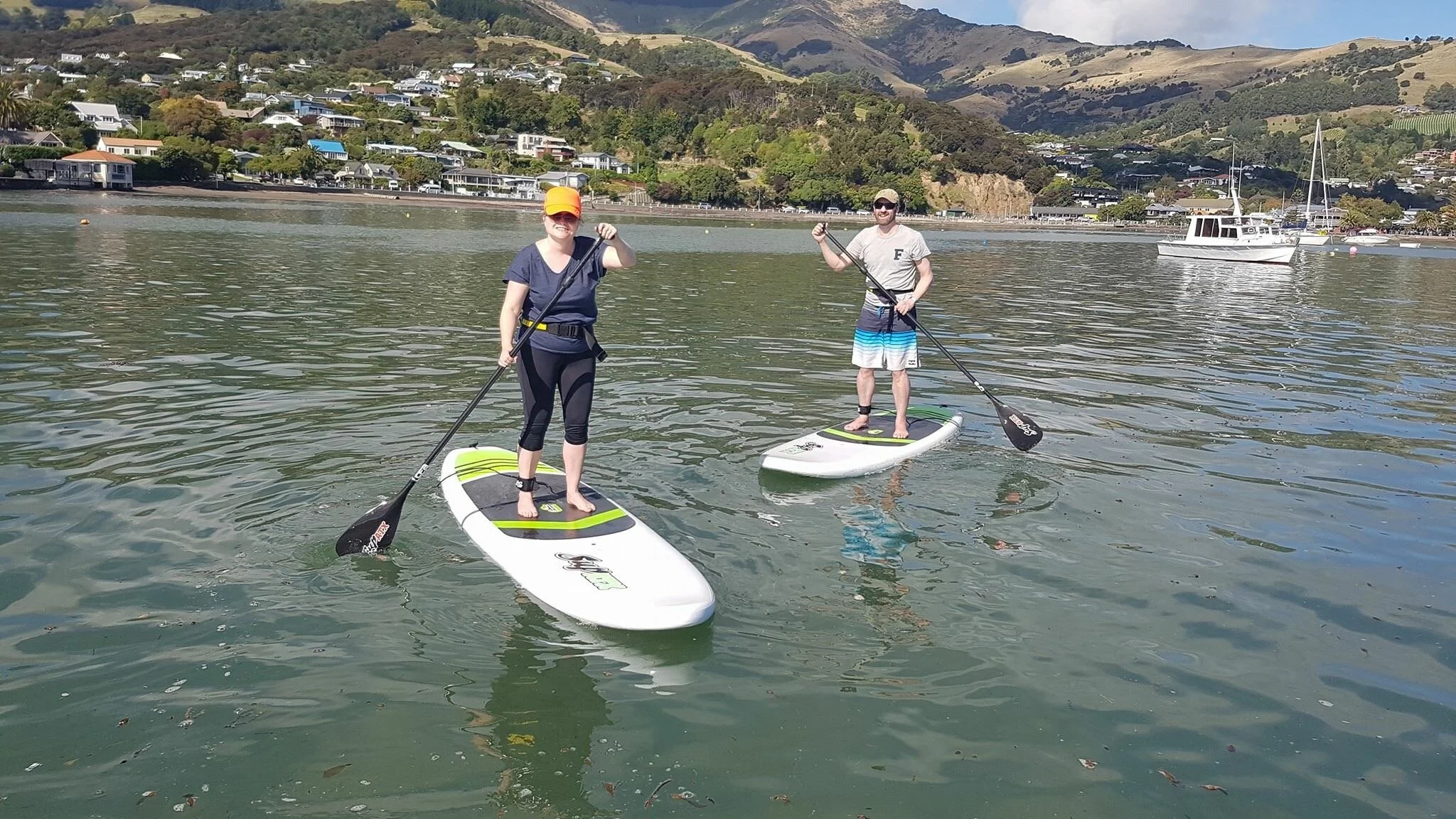
Paddle boarding in Akaroa Harbour
Akaroa was partially settled by the French (after some confusion and agreement with the British) and their influence is visible in the town still today. Street signs and lighting is in the French style, lots of place names are French and there is even a French cemetery to visit. For a small place it has a lot going for it, with a lovely waterfront promenade to enjoy, a small yet attractive beach and numerous jetties from which to launch boats. Trips leave daily for nature tours, swimming with the world’s smallest Hectors Dolphins (a pod live within and around the harbour), fishing and sailing. There are kayaks to hire which I highly recommend. On a warm day there is nothing better than making your way around the harbour edges, spotting local seabirds.
The town itself has an array of accommodation options, some waterside whilst others offer bush or sea views. The café / restaurant / bar options in town are numerous, including a former toilet block that has been converted into a bar overlooking the beach.

There are plenty of balconies from which to take in the views in Akaroa
he town butchers is one of the very best in New Zealand – it has an array of options if you are looking to self-cater – choose from some award winning sausages, local Akaroa salmon or even homemade lasagna. Whatever you do though don’t miss out on the fish and chips – there are two outlets in Akaroa, both being excellent. The one on the waterfront is a top spot as proven by the queue often stretching outside the door. Whilst Murphy’s positioned just behind the main through fare on a corner serves up only fish caught that morning.
There is a cooking school that offers regular classes with cuisine choices from around the world and a small native bush area to stroll through and if you are lucky listen to the bellbirds and tui chorus. A short walk further up from the town is the Akaroa lighthouse. It is open on Sunday afternoons to explore, but otherwise the views across the harbour are reward enough for the short stroll around to it – I’ve even spotted a couple of dolphins from this spot making their way across the harbour.

The views are equally splendid from the water too….
Journey into the Abel Tasman National Park
The road journey to the Abel Tasman involves coastline, wineries, and cute townships
he Abel Tasman National Park, a short drive from Nelson at the top of the South Island is an ideal spot for hiking or kayaking.
The coastal track here is classed as one of the countries great walks. It can be walked over a number of days or in shorter periods.
Water taxis buzz along the coastline servicing all the various drop off points for hikers, day trippers and kayakers. There are a number of idyllic camping spots to spend an unforgettable night. Some only accessible by water.
I’ll be writing another blog shortly all about hiking the track over a few days. It’s one of the most easy and accessible multi day walks in New Zealand and recommended for beginners to overnight hiking who might be slightly nervous about a first adventure into the bush alone.

The estuary at low tide at Marahau, gateway to the Abel Tasman
My weekend started with a drive from Nelson through to Motueka. Motueka is a service town for the neighbouring areas but it’s also fast becoming a top spot to spend a couple of days. As well as splendid scenery it also has a number of wineries dotted around it’s outer reaches. There are some great eateries as well – T.O.A.D Hall is a popular spot on the outskirts of town catering for an array of needs. They have their own juice bar and ice creamery. They serve great breakfasts and even open on an evening for pizza. The place is huge with a fantastic beer garden out the back. The Smoking Barrel is becoming famous for its donuts, which are apparently incredibly creative. Elevation is a top coffee house but my favourite is Patisserie Royale. Stock up early morning for both breakfast and lunch and you can’t go wrong. The house-made pies and quiches are divine. They have a great choice of sandwiches, including exciting vegetarian versions. However as you’d expect from a French bakery it’s the patisseries that win out. A massive array of pain au chocolat, pain au raison, almond tarts, the list is endless. Choosing which one to sample is the hardest part. But trust me when I say, you cannot go wrong.

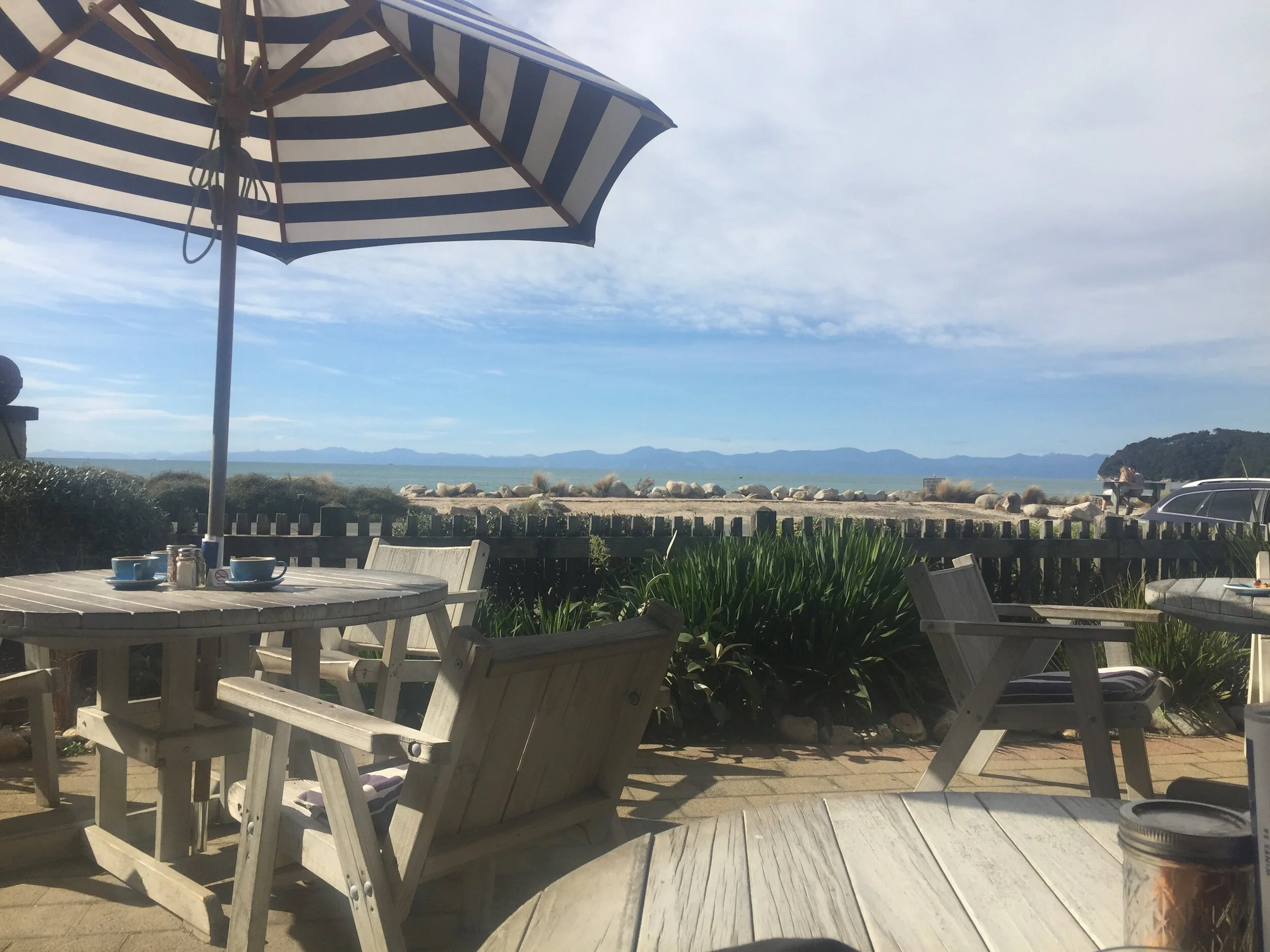
Overlooking the beach at Marahau
Leaving Motueka the road snakes through farmland and through small settlements that are present mainly to support the fruits and hops that grow prolifically in this area. As you turn off towards Mapua the landscape alters once again to dense bush and pine forest. This part of the country suffered from some devastating flooding a few years ago and the road is only just back to one piece again. The approach into Mapua itself is through coastal wetlands. The road curves around an estuary that is popular with fishermen when the tide is right. Mapua is small, spread out along the coastline. As you would expect there are a number of kayaking and water taxi operators here. There are motels and campsites and a couple of worth café/restaurants. I will talk about accommodation and food options in the area in another blog shortly.
At the far end of Mapua as you follow the coastline – which can’t be missed as it runs alongside the roadway the bush strewn landscape of the Abel Tasman National Park looms up above. Coming next, the Abel Tasman National Park
a big sigh, the Road to Milford Sound
The brilliant greens of the Lake Gunn nature walk on the Milford Sound road.
They say the journey is sometimes as good as the destination. And on occasions it can actually be better.
The whole aim of this blog is to encourage everyone to get out there are try things and sometimes that involves a long drive, sometimes it’s just down the road.
Milford Road is one of those journeys that transcends your everyday – it is something unforgettable and is worthy of the drive even if there was nothing worthwhile to see at the end. The end of this road though is Milford Sound – reckoned by many to be possibly the eighth wonder of the world. (please see my earlier blog about Milford Sounds boat cruises).

Taking a boat cruise at Milford Sound is a must do…
Milford Road leaves the township of Te Anau behind and follows the side of it’s namesakes lake for quite some time. Rolling hillside and lakeside accommodation passes by. In the distance large mountains loom their lofty peaks covered in snow. On the left hand side you pass the docking point for the boat ferrying hikers to the start of the legendary Milford Track, and then the road suddenly turns left and those mountains lie ahead of you. The farmland continues with fields full of hardy sheep, paradise shell ducks and some resilient cattle. This continues until you reach Etherington Valley, a long road takes you through the its heart alongside a braided river which roars through the valley.

Ethrington Valley on the road to MIlford
There are viewing points along the road to take photographs of the oncoming wilderness. A short drive further down the road reaches knobs flat, an accommodation and information point with an essential bathroom stop if one is needed. You then venture onwards until the landscape turns to bush and several Department of Conservation campsites hidden a short distance away. The next stopping point is on the left hand side with long pull off for Mirror Lakes.

A South Island Robin is a reluctant poser for photographs at Mirror Lakes, Milford Road
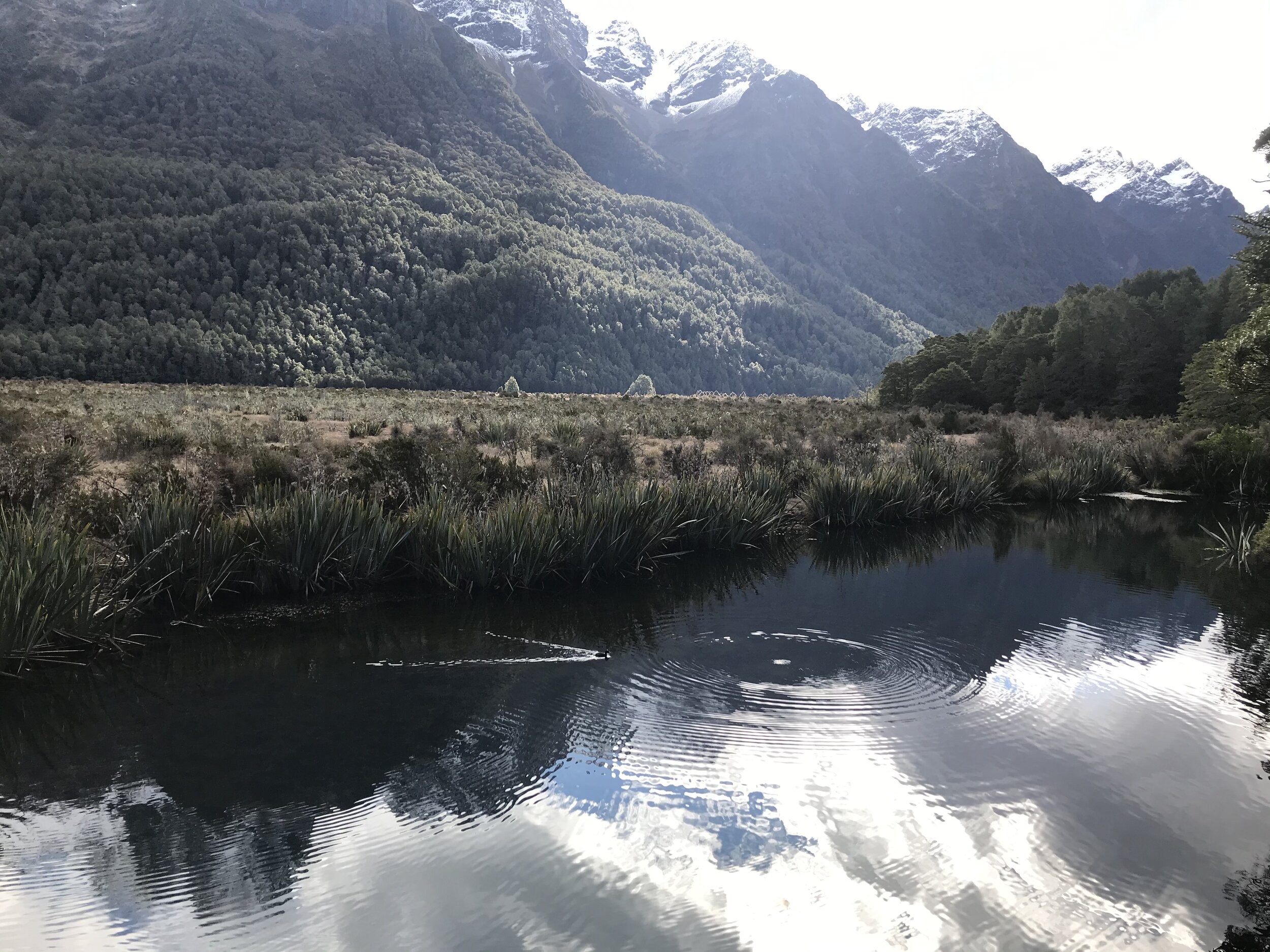
A boardwalk takes you above these small lakes to allow you a good vantage point to see the reflection in the water of the towering mountains looming above. They have even kindly left a sign above the lake reflecting the name of the place, very clever. On my visit I was alone for much of the time and that ensured lots of wildlife viewing – a grey duck, native to New Zealand was nearby pecking at insects floating on the water. I also spied a rare South Island Robin, which pirouetted a few times around me but didn’t seem to keen to pose for it’s photograph for some bizarre reason….

A rare ‘grey duck’ samples some insect life on the Mirror Lake surface. The reflection from the mountains above is also clear
As I drove onwards the bush became thicker and darker, creeping up alongside the roadway as if trying to reclaim it as its own. After a small one lane bridge a sign pointed towards a campsite and a nature walk. Intrigued I drove a short distance and parked up. An information board advised me that there was a 45 minute loop walk to enjoy down to the shore line of Lake Gunn.
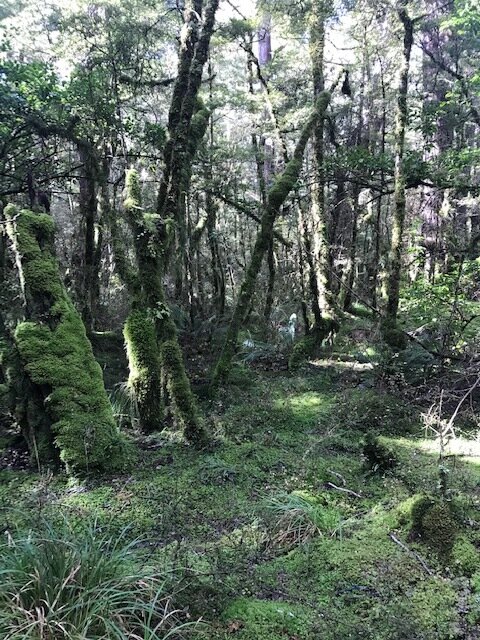
The green moss floor that greets you in the Milford Road bush
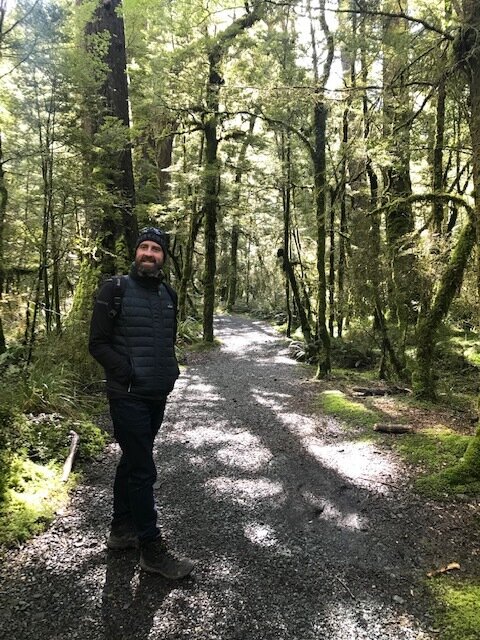
What struck me first was how green everything was. It was a shade of emerald bright and dazzling in the sunlight but dark and unnerving in the gloom. Everything was smothered in a moss of some sort. Trees grew out of other trees and hardy ferns covered the forest floor.
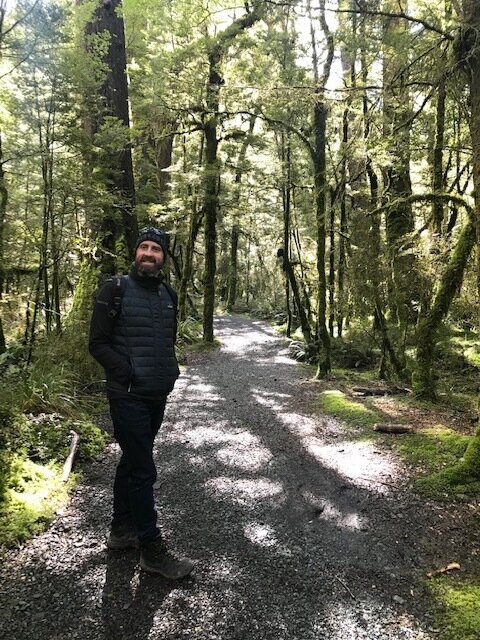
Dan at the start of the Nature Walk through native forest to the shoreline of Lake Gunn
An opening in the bush bought me to Lake Gunn, a lake surrounded on all sides by dense native bush. The water lapped at the small stones at my feet as I stood and admired the view. There wasn’t a sound to be heard except the lapping of the shallow clear water. I learnt that the lake stretched over 3km’s and I was only looking out at a small part of it. I continued on the loop walk back to my car listening to the local bird song echoing from the branches up above.

Trees growing up and around and out of other trees are common sights in this damp forest
The road as I drove onwards was now becoming narrower and windier. I passed a sign informing me that it was the last campsite available to Milford Sound, I was entering the true wilderness area.
I started climbing upwards noticing how the bush appeared to be getting thicker in places. The road now seemed to be cut out of the cliffside with a steep slope to the side of me along which waterfalls plummeted down. At least that’s what I think they did, as at this point my knuckles were white from the grip on my steering wheel.
Mountains surround you on all sides on Milford Road
On the way up to Milford the cloud was low and a fog had settled across the valley obscuring the views. On my way back however the sun had burnt it all away exposing the vast valley below. The pull off at the viewing point overlooking Hollyford Valley is named pops point after one of the original caretakers who sadly got swept away in an avalanche whilst trying to clear the road.
Coming next, the giant boulders, unfathomable terrain and Homer Tunnel

A day out in Akaroa, New Zealand's little slice of French paradis
The Star Gazer on a clear night is the perfect camping spot on at Onuku Farm Hostel
The drive to Akaroa across the rugged hills of the Banks Peninsula is worthy of a day trip in its own right. There are two routes – a tourist route high above the peninsula which offers great views and turns offs to some of the regions most remote beaches – and the main route
(when I say main it’s all relative) which takes you through small townships and pass pretty bays.This blog though is about Akaroa itself and I will focus on the two memorable journeys to get there in a later article.
Akaroa is a small seaside settlement set in an idealyic location at the end of a long harbour bearing the same name. It has a French feel to it with French street names and Parisian style signs. The story is that the French originally thought they had agreed with local Maori to
inhabit the area only to find on their return that the British has claimed the area for themselves following the signing of the Treaty of Waitangi. However, the French that did arrive where invited to stay and their influence on the area is still felt today.Akaroa is a pretty place to just wander around, there are a couple of beaches to enjoy and an historic lighthouse. As you walk along the waterside boardwalk there are numerous cafes and restaurants to enjoy with pavement seating if the weather is good. There is even a
waterside bar (Harbar) which has been developed from the old toilet block!
Paddle boards can be hired from the beach and a little further around the bay
there are kayaks and paddle boats available.If you venture to Akaroa though (and please do) the main incentive is to get out onto the water. There are several boat trips to choose from and all take in the gorgeous harbour (Akaroa actually means long harbour) and seek out the resident Hector Dolphins that frequently inhabit the bay. Hectors are the worlds smallest dolphins and stand out due to their rounded dorsal fin. Several of the operators allow swimming with the dolphins if the conditions are right. The boat trips come in all shapes and sizes so it’s entirely up to you which you select. The one with the dog spotting dolphin is recommended though….how could you possibly resist?
After an exhausting fun packed day out on the harbour it’s worth indulging in some fish and chips and this is something Akaroa does well. There are two options – Akaroa Fish and Chips which is situated on the seafront and often has a queue spilling out the door, or Murphys which is tucked away down a side street. Blue cod is most likely available at the first option and it is very good, but Murphy’s actually catch their own fish daily. So your choice is what has been caught by their fishermen that morning! Murphys has a kiosk on the main wharf which is popular in the summer months. There is also a caravan serving delicious pizza back on the main shopping street in summertime – if he’s open you’ll spot his sign outside – the salmon pizza is a must try, as is the standard Margaretia.
As night falls the options in this small town keep coming. You can choose to join one of the excellent trips to the family farm over the headland in Pohatu. The beach here is called Flea Bay and its home to the most successful colony of little blue penguins to be found in all of Australasia. The evening tour starts at dusk as the little penguins begin returning to their nests after a day out fishing. You can easily spot them returning from the sea and if your lucky you will spot a few in their nests. They are quite territorial and will soon warn you if they don’t want you close, one actually tried to peck me when I crouched down for a closer look! Another of the boxes opened by my guide revealed two youngsters eagerly awaiting their parents return. The guides use the tours to monitor the many boxes. It is a truly wonderful tour as you learn about the penguins and the farms owners who have done so much for conservation in this area. The scenery you encounter isn’t too bad either. They also run day trips and offer guided kayaking tours.
Another must try after dark activity for the adventuress is NightSUP paddle boarding. LED lights are fitted under the boards so that the sea water beneath is lit up to reveal all the underwater activity. It is a magical sight. There are huge stingrays that inhabit the shallow waters and are often spotted underneath the paddle boards.
Akaroa is also home to a popular cooking school. It’s worth checking out their timetable to see what availability there is for attending one of their courses. They offer many different types depending on taste, so you can indulgence in Italian, Spanish or even Asian cuisine.
They all come with excellent reviews and who doesn’t love an afternoon wineing and dining.Of course there are many other things to try in Akaroa and it might be worth extending your stay. Excellent accommodation options can be found in the area. One of my own favourites is
slightly out of town at Onuku Farm Hostel which offer Star Gazers - small tent shape huts with glass panels above your head – you can well and truly star gaze here on clear evenings. Another top spot is at the Pohatu Penguin colony where you can stay overnight and fall asleep to the sound of penguin chatter. If you wish to stay in Akaroa itself I would recommend the Criterion Motel.
A few snaps from our time in Akaroa. Star Gazing, paddle boarding and penguin spotting…..